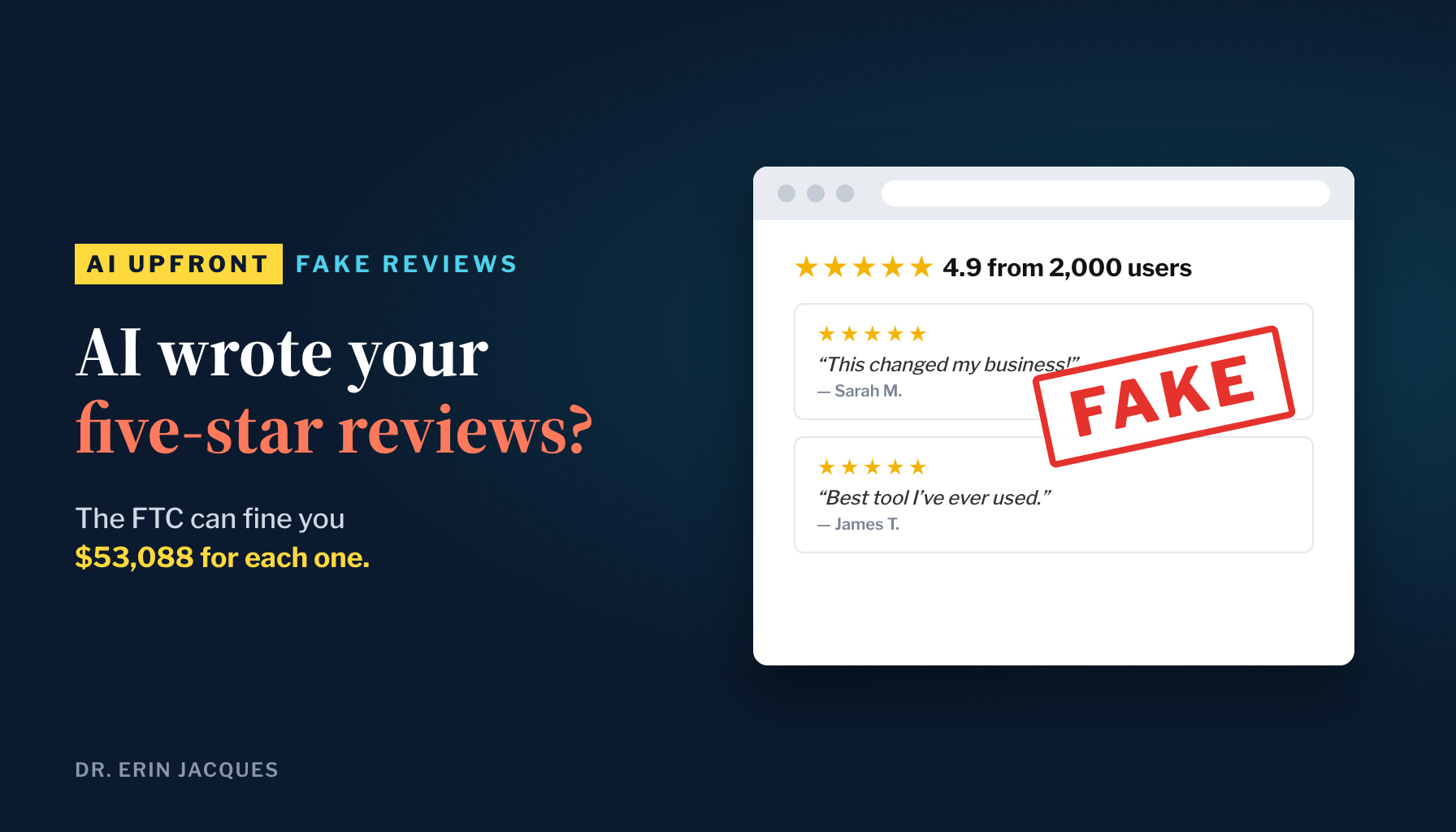
Your new web app looks finished. Clean design, a pricing table, and a row of glowing five-star reviews from happy customers.
You don’t have customers yet.
When you ask AI to build a landing page, it fills the empty spots so the page looks real. That often means testimonials from people who don’t exist, a “4.9 stars from 2,000 users” badge, and quotes like “This changed my business!” signed by “Sarah M.” Most builders keep them to swap out later. Then they launch.
Can you really get fined for fake reviews?
Yes. In August 2024, the Federal Trade Commission finalized a rule banning fake reviews and testimonials. It took effect on October 21, 2024. The rule bans reviews that misrepresent who wrote them or what they experienced, and it names one category specifically: “AI-generated fake reviews.”
The FTC can seek civil penalties against businesses that knew, or should have known, their reviews were fake. The 2025 maximum is $53,088 per violation. Do the math on a landing page with six invented testimonials.
Is the FTC actually enforcing this?
It has started. In December 2025, the FTC sent warning letters to 10 companies about possible violations. Those letters weren’t findings of wrongdoing, but they warned of federal lawsuits and the same per-violation penalties. Lawyers called it the first public use of the rule as an enforcement tool.
Placeholder reviews feel harmless while you build. The moment you launch, they become claims you’re making to customers.
Dr. Erin JacquesWhere do fake reviews hide on an AI-built site?
The obvious ones sit right on the page. The rest are harder to spot:
- In the code that feeds Google. AI often adds hidden data that tells search engines your product has, say, 4.8 stars. Visitors never see it, but Google does.
- In sample data. AI seeds your database with fake users and reviews so the app looks alive while you test, and that data can ship with your launch.
- In images. A screenshot of a “customer text” or a badge graphic is still a claim.
- In your numbers. “Trusted by 10,000 founders” is a claim too. So are follower and user counts you can’t back up. The rule also covers fake social media influence.
What’s changing for people who build with AI
AI made it easy to launch something that looks established on day one. That’s the opportunity and the trap. Regulators now treat a review as a factual statement about real customers, no matter who, or what, wrote it.
The builders who win won’t be the ones with the most stars. They’ll be the ones whose stars are real.
Your move: audit your proof, then earn the real thing
Step 1: Run the audit. Paste this into Claude, Lovable, Cursor, or whatever you build with:
Audit my web app for fake or unverified social proof. Find every review, testimonial, star rating, customer count, and follower or user number, including ones hidden from view: in the page code that sends star ratings to Google, in placeholder or sample data you added while building, in image text and alt text, and in my database's starter data. For each one, tell me where it is and whether it came from a real customer. Remove anything that didn't. If a review came from me, an employee, or someone I paid or gave something to, add a clear disclosure. Then list everything you changed.
Step 2: Disclose your connections. The rule requires reviews from insiders, like you, your staff or family, to clearly say so.
Step 3: Collect real reviews the right way. You can ask early users for honest feedback, and even thank them for it, as long as the reward doesn’t depend on the review being positive. That’s straight from the FTC’s rule. I’m not a lawyer, and this isn’t legal advice.
Three real reviews beat thirty fake ones, legally and with buyers. This move protects you, and it gives you proof your competitors can’t fake. It helps you stand out.
You can build faster than ever with AI. Make sure what you launch is true.
Inside Leveraging AI, we build web apps that are ready for real customers, from the first line of code to the first real review.
Sources
- Federal Trade Commission: Federal Trade Commission Announces Final Rule Banning Fake Reviews and Testimonials
- Federal Trade Commission: FTC Warns 10 Companies About Possible Violations of the Agency's New Consumer Review Rule
- Federal Trade Commission: FTC Publishes Inflation-Adjusted Civil Penalty Amounts for 2025
- Benesch: Five Stars, Zero Tolerance: FTC Turns Up Enforcement Under Consumer Review Rule

Dr. Erin Jacques is a professor, AI strategist and the founder of Leveraging AI and ChatifyIT. She helps entrepreneurs and creators use AI safely and turn what they know into income.
AI Upfront
Straight talk on the AI economy, and how to claim your place in it. Three short emails a week: what's true, what's changing, and your move.