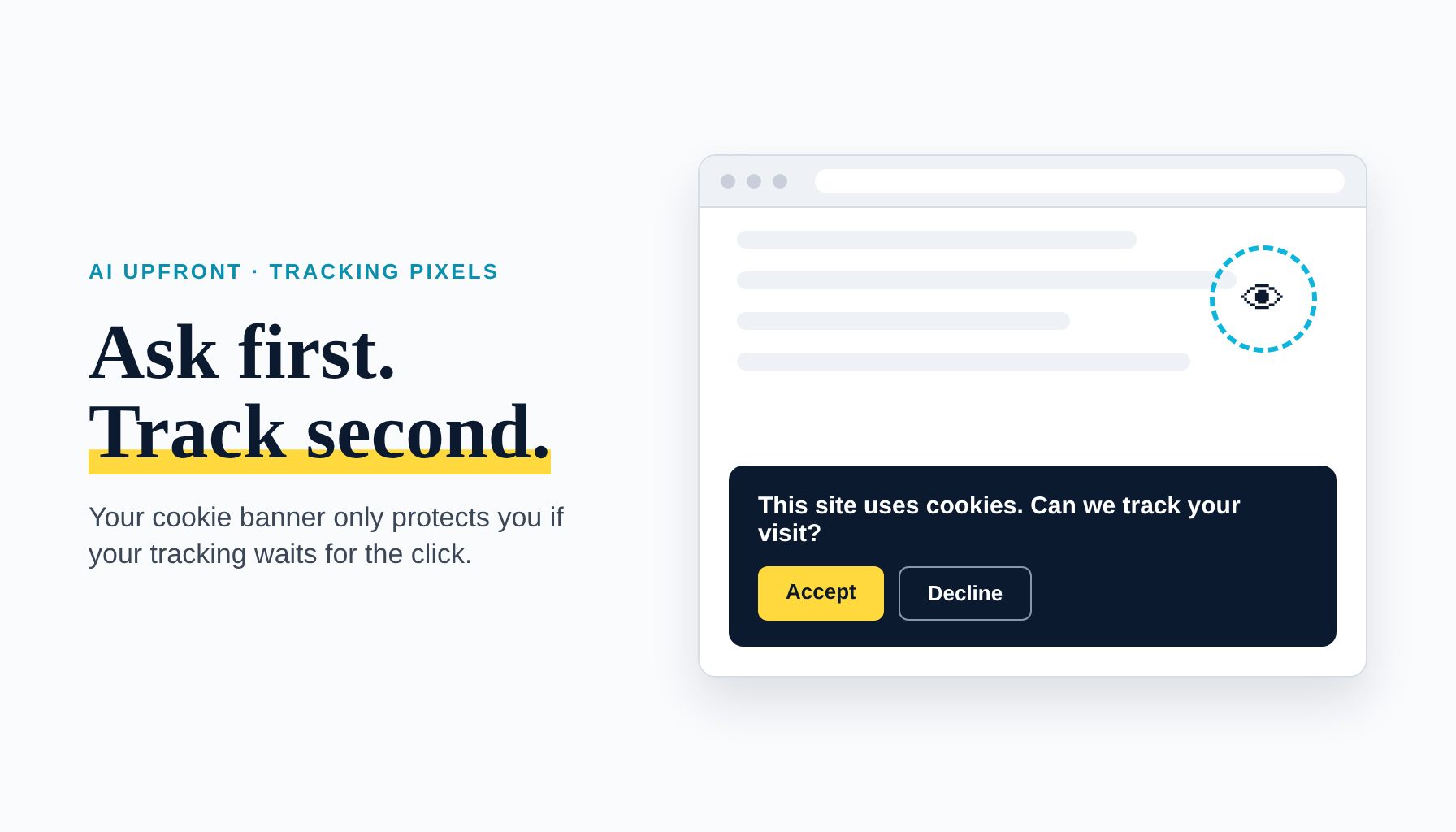
Vibe coding makes it easy to launch a web app in a weekend. It also makes it easy to launch one that breaks a privacy law before your first visitor clicks anything.
The problem is a tiny piece of code called a tracking pixel, and the question of when it turns on.
Can a tracking pixel really get you sued?
Yes. A tracking pixel is a small snippet from companies like Meta, Google or TikTok that reports what visitors do on your site so you can run and measure ads. Under the California Invasion of Privacy Act (CIPA), a wiretapping law from 1967, plaintiffs argue that sending visitors’ activity to a third party without permission is like letting someone listen in on a phone call.
More than 4,700 digital wiretapping lawsuits have been filed since 2022, according to Reuters. That’s over a thousand a year. The law allows damages of up to $5,000 per violation, and these cases are often filed as class actions.
To be clear, courts haven’t settled whether a pixel counts as wiretapping. In one 10-day stretch this April, four California courts ruled on nearly identical claims and reached different conclusions. But you don’t have to lose a lawsuit for it to cost you. Defending one, or settling a demand letter, is expensive either way.
Does a cookie banner protect you?
Not by itself. What matters is timing.
In 2022, a federal appeals court ruled in Javier v. Assurance IQ that CIPA’s wiretapping section requires consent before the recording happens. Agreeing afterward doesn’t count.
That’s why the 2026 lawsuits focus on a narrow question: when did the tracking start compared to the click? Many complaints say the pixel loaded the second the page opened, before anyone touched the banner. Others say tracking kept running after the visitor clicked “decline”, because the banner was never connected to the code collecting the data.
Having a banner and actually waiting for permission are two different things.
Dr. Erin JacquesWhat if I’m not in California?
You can still be targeted. CIPA protects people in California, not California businesses, so if a California resident visits your web app and the tracking captures their activity, the law can come into play. Out-of-state businesses are already getting demand letters.
Where you’re based still matters in court. Whether a California judge can hear a case against an out-of-state business is decided case by case, and many have strong defenses. But fighting that question still costs money, so it’s easier to just make your app wait for permission.
Didn’t California just fix this?
Only partly. On September 30, Governor Gavin Newsom signed SB 690. Starting January 1, 2027, private plaintiffs can no longer sue websites under CIPA’s “pen register” section, a different legal theory about tracking.
SB 690 leaves the wiretapping section untouched, and that section covers pixels that fire before consent. Lawyers at Baker Donelson expect plaintiffs to swap the claims SB 690 blocked for wiretapping claims. Newsom himself urged lawmakers to keep working on CIPA reform.
Why vibe coders are especially exposed
When you ask an AI tool to “add the Meta Pixel” or “add Google Analytics,” it usually installs the standard snippet at the top of your page, where it loads the instant someone arrives. Ask it for a cookie banner, and you’ll get one that looks right. Nothing guarantees the banner actually controls the tracking.
A few years ago, a developer or agency would have caught this. Now you’re the developer, so checking it is your job.
What’s changing: building fast now includes checking what you built
AI made launching a web app cheap and fast. It didn’t make the legal responsibility go away.
That creates a gap, and a gap is an opportunity. Most people building with AI will never check when their tracking turns on. The ones who do will launch with less risk, and if you build sites for clients, a consent check is a real service you can offer.
Your move: ask first, track second
Step 1: Tell your AI exactly what you want. Before you launch, paste this into Claude or whatever tool built your app:
Make sure no tracking pixels, analytics, or third-party scripts load until the user clicks accept on my cookie banner. If they decline, make sure nothing fires at all.
Step 2: Check it yourself. A prompt is an instruction, not proof. In Chrome, open your site in a private window, right-click and choose Inspect, then click the Network tab and reload the page. Don’t touch the banner. Type facebook, google or tiktok in the filter box.
- Before you click anything: nothing should show up.
- After you click “Decline”: still nothing.
- After you click “Accept”: now the tracking requests should appear.
If anything shows up before you accept, send that back to your AI and fix it before you launch.
This follows the rule the courts set in Javier: consent comes first, tracking comes second. One note: I’m not a lawyer, and this isn’t legal advice. If your app collects sensitive information like health or financial data, talk to a privacy attorney.
This check gives you an edge. Plenty of people can build fast; far fewer can prove their site waits for permission.
The people who win in the AI economy won’t just build fast. They’ll build things they can stand behind. If you want to build with AI the right way, join us in Leveraging AI.

Dr. Erin Jacques is a professor, AI strategist and the founder of Leveraging AI and ChatifyIT. She helps entrepreneurs and creators use AI safely and turn what they know into income.
AI Upfront
Straight talk on the AI economy, and how to claim your place in it. Three short emails a week: what's true, what's changing, and your move.