Every major shift in technology has one thing in common. It lowers the barrier to building. That is the thing worth watching right now, and almost nobody is watching it — because the part that changed isn't the AI everyone is looking at. It's the plumbing underneath.
Ask most people how their AI assistant reads their email, or updates a database, or sends a message in Slack, and the conversation stops. They can name ten AI tools. Almost none can explain how any of them connect to anything.
That connection is where everything was stuck.
What an API actually is
An API is one piece of software asking another to do something. Your weather app doesn't own weather data — it asks a weather service, and the service answers.
Every request needs three things: where to send it, what information to include, and what kind of answer to expect. A developer reads the documentation once, writes code that matches, and it works forever after — because the software already knows all the rules before it ever runs.
That assumption held for two decades. It is why APIs are clean, predictable, and everywhere.
Why AI can't use one on its own
Because AI doesn't know the rules ahead of time.
A traditional program is told exactly which endpoint to call and what to send. A model has to work it out — which tool fits the request, what to ask for, what to do with the answer, and what to do next. Nothing in a conventional API tells it any of that. The documentation was written for humans, and the code was written by humans in advance.
So connecting AI to real tools meant writing custom integration code for every single tool. Gmail needed one. Slack needed another. Your CRM needed a third. Add a tool, and you write it all again.
The barrier has dropped before
- Writing HTML by hand. If you wanted a website, you learned to code. That was the price of entry, and everyone else was locked out.
- Website builders. Suddenly you didn't need to code at all, and millions of people got in who never could before.
- No-code tools. The barrier dropped again. People built real businesses without writing a line.
- AI and MCP. Same pattern, same moment, happening right now.
Does MCP replace APIs?
No — and this is the part most explanations get backwards.
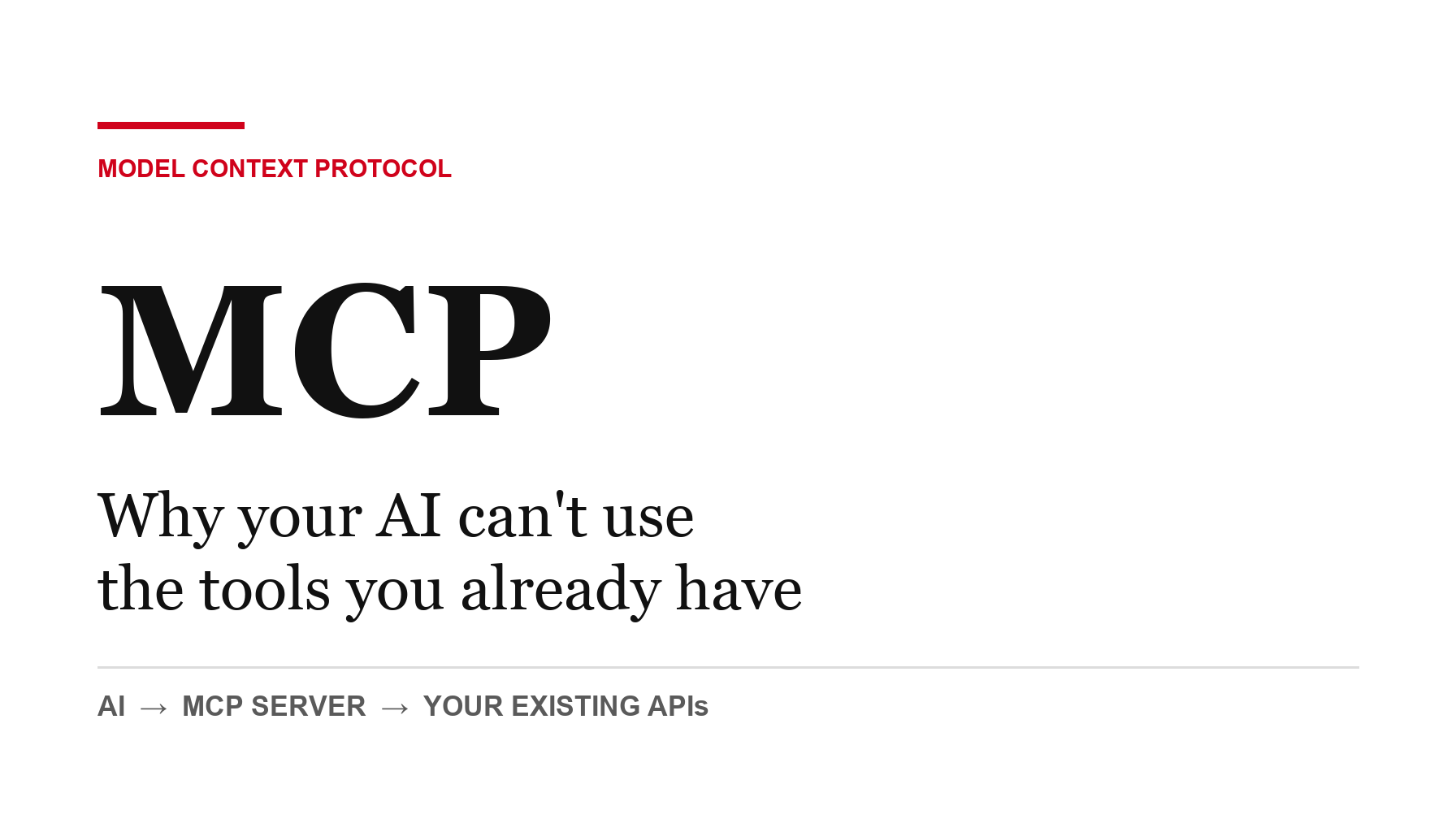
An MCP server sits between the AI and your existing APIs. The AI asks in plain language, the server describes what it can do, the API does the work, and the result comes back. Your APIs do not change. And because the protocol is shared, the same server works whether you are using Claude, ChatGPT, or Gemini.
The APIs are still doing the actual work. What changed is who knows how to use them.
MCP doesn't eliminate developers. It dramatically cuts the custom work needed to connect AI to the applications you already use every day — which means building with AI stops being something only engineers get to do.
Every one of those earlier shifts made someone. Somebody learned HTML first. Somebody found the website builders first. Somebody moved on no-code while everyone else waited. This one is happening right now.
The APIs are still doing the actual work. What changed is who knows how to use them.
Dr. Erin Jacques
Dr. Erin Jacques is a professor of informatics at the City University of New York and the founder of Leveraging AI and ChatifyIT, where she helps people build and monetize AI-powered web apps people pay to subscribe to.
Get AI News Weekly
How to build and monetize with AI, in one short email.