A dental company took a booking process that left patients waiting up to an hour and got it down to 15 seconds.
An aviation company took contract processing from days to minutes.
Local businesses using AI agents to answer their leads reported a 45% jump in conversion.
None of them are AI companies. Every one of them found one expensive bottleneck inside a business they already understood — and built AI around it.
That’s the pattern I want you to see. Because the best AI business for you to start probably isn’t a new idea. It’s a problem you already know.
I didn’t start with AI. I started with a problem.
When I started learning AI, I had no experience in it. I’m a professor of informatics and biostatistics, and a lot of my research means analyzing huge amounts of information online. Before AI, that took weeks — and research assistants, and programmers.
So I started building automated pipelines. My earlier studies looked at a hundred items at a time. This year, one of them processed more than ten thousand.
But I didn’t go looking for problems AI could solve. I already understood the problems. AI gave me a new way to solve them.
So don’t ask, “What AI agent should I build?” Ask, “What problem do I understand well enough to build an agent that solves it?”
Why now
Deloitte surveyed more than 500 U.S. business and technology leaders this summer. Only 5% said their business processes were highly prepared for AI agents. But 74% expect nearly half their processes to be redesigned around agents within four years.
Companies know their workflows are about to change. Most haven’t figured out how. That’s the advantage of someone who actually understands the workflow.
What these opportunities look like
Dentistry. FDC Dental’s booking ran through chat, and the queue could swell to 2,000 requests — patients waited up to an hour. They built a system that lets a patient have a conversation, pick a clinic and book. According to Google Cloud’s case study, it now takes as little as 15 seconds. They didn’t start with an agent. They started with a booking problem.
Real estate. Realtor.com’s teams were pulling keyword research from multiple tools by hand. They built Claude agents that pull the advertising data, analyze it and prepare recommendations — with a human still reviewing before anything goes live. According to Microsoft Advertising, insight that took manual work now surfaces in seconds.
Aviation. Unifi’s staff spent hundreds of hours a year processing contracts, some over a hundred pages. They attacked one workflow: extract, classify and validate the key terms. According to Microsoft, processing went from days to minutes.
Notice what they have in common. The opportunity wasn’t replacing the expert. It was fixing everything happening around the expert.
And all three could afford to build it. Most businesses with the exact same bottleneck can’t. That’s the opening.
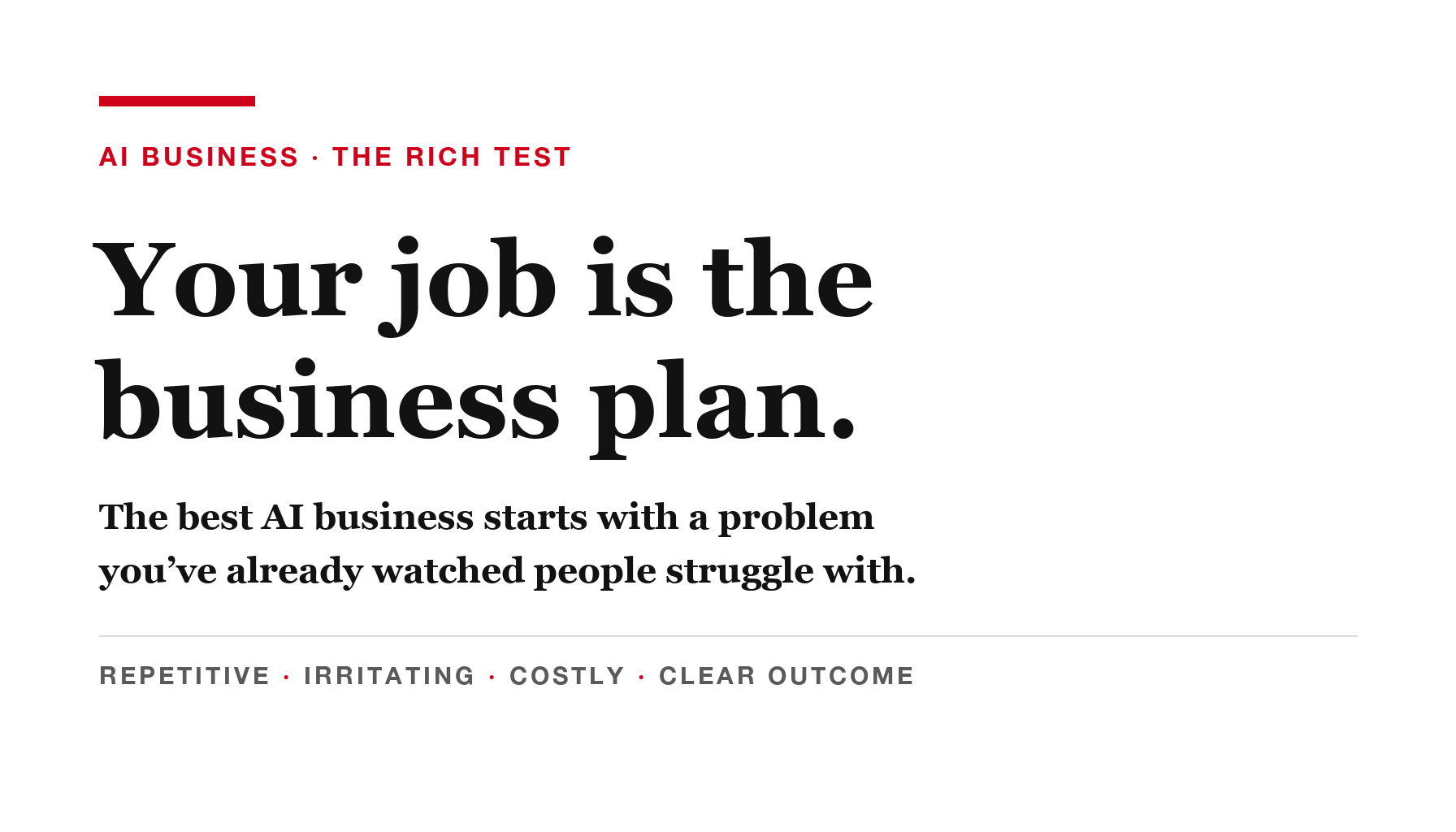
The RICH test
When you find a problem inside an industry, run it through four questions.
R — Repetitive. Does someone do this again and again? Once a year isn’t where I’d start. Thirty times a day is.
I — Irritating. Does somebody hate doing it? People don’t pay because technology is impressive. They pay to make problems disappear.
C — Costly. Is there money attached — hours, lost customers, missed leads, an expensive professional doing work that doesn’t need their expertise?
H — Has a clear outcome. Can you tell if it worked? Was the appointment booked? Was the document processed?
When all four show up together, pay attention.
People don’t pay because technology is impressive. They pay to make problems disappear.
Dr. Erin JacquesWho writes the check?
A RICH problem still isn’t automatically a business. There’s one more question: who loses money while this goes unsolved?
A plumber misses a call. A medspa doesn’t answer an inquiry. A car dealer takes three hours to get back to someone ready to buy. That isn’t an inconvenience. There’s revenue attached.
Podium built AI around exactly that bottleneck for local businesses. According to OpenAI’s case study, businesses using its agents reported an average 30% increase in revenue and 45% higher lead conversion. Those are vendor-reported numbers — but the lesson isn’t Podium. It’s the problem they chose.
So ask it about your own idea: if I make this problem disappear, who financially benefits? That’s your customer.
Run it on your job
Grab a piece of paper.
- Write down the industry you know best — not the exciting one, the one you actually understand.
- List three things that happen in it over and over.
- Cross out the ones nobody hates.
- Cross out the ones that don’t cost anyone time or money.
- Of what’s left, can you define what success looks like?
- Ask: who writes the check if this disappears?
What’s left is where you start investigating.
Then go narrower. “Teachers spend too much time on admin” is too broad — which admin? “Realtors need help with leads” is too broad — where exactly are the leads lost?
Narrow matters for money, too. McKinsey’s August analysis of agent economics found these workflows are more expensive to run than most companies expect. The value has to clear the cost. So don’t build an AI employee that does forty-seven things. Solve one expensive problem extremely well.
Your experience is the advantage
If you’ve worked in an industry for five, ten, twenty years, you’ve collected something valuable: domain knowledge. The spreadsheet one person updates every Friday. The workaround nobody ever wrote down.
A developer looking at your industry knows more about AI than you do. You know the workflow.
That’s the biggest misconception about this whole opportunity. People think they have to become AI experts first. Your advantage may be the expertise you already have.
Problem first. AI second.
This is exactly what we work through inside Leveraging AI: finding the problem, then building the thing that solves it.

Dr. Erin Jacques is a professor of informatics at the City University of New York and the founder of Leveraging AI and ChatifyIT, where she helps people build and monetize AI-powered web apps people pay to subscribe to.
Get AI News Weekly
How to build and monetize with AI, in one short email.