
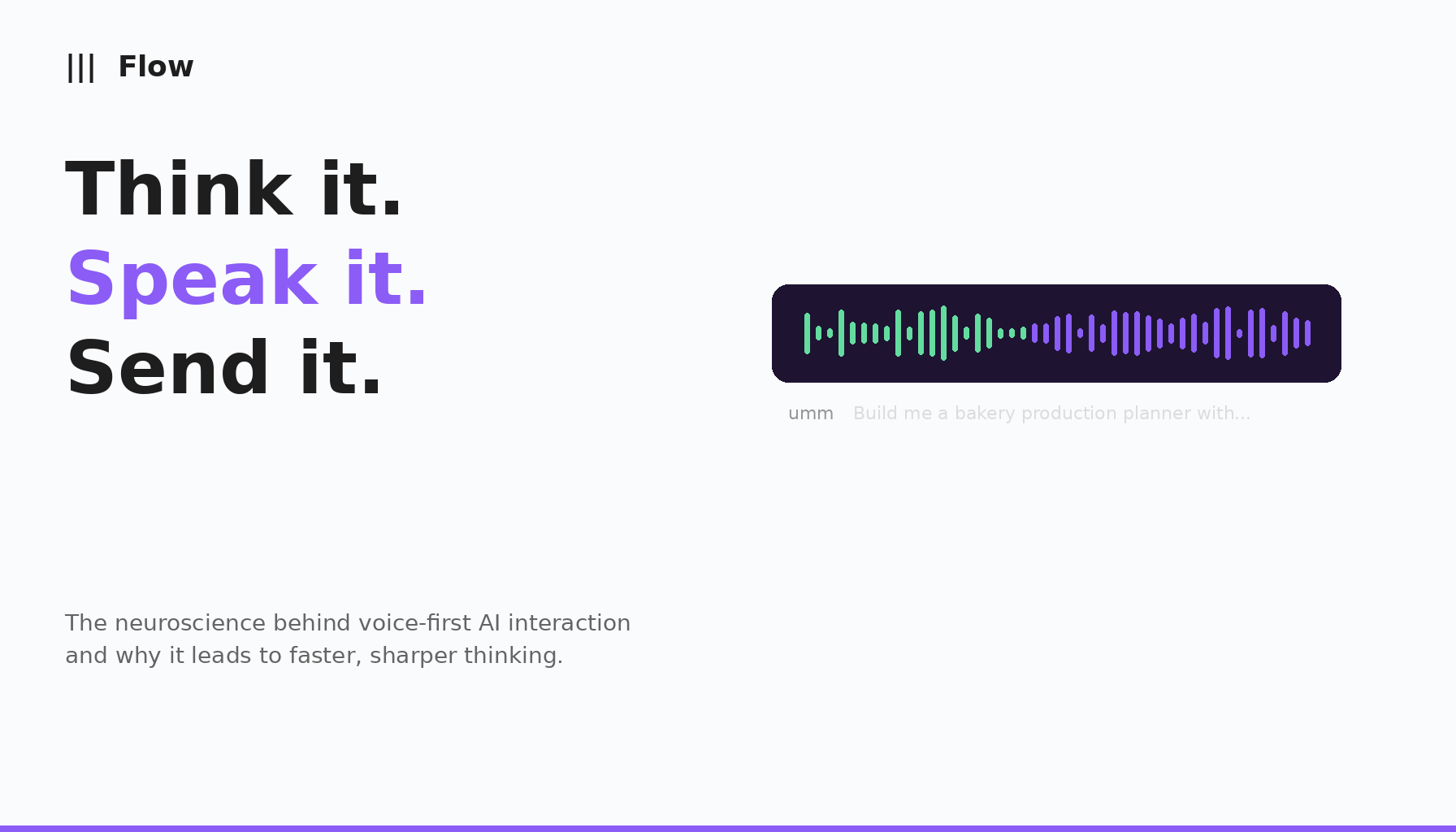
Speaking to AI instead of typing activates externalized cognition, shifting the prefrontal cortex from rumination to evaluation. Research shows the anterior cingulate cortex runs a cost-benefit analysis on every task, and when AI eliminates the hardest starting point, dopamine drives motivation and momentum. Voice-first AI interaction may be the most underrated productivity shift of 2026.
What Happens in Your Brain When You Speak Your Thoughts to AI?
Most people interact with AI the same way they interact with a search engine — they type. But there's a neurological difference between typing a question and speaking one out loud.
When you speak your thoughts and read them back, you activate what cognitive scientists call externalized cognition. Your prefrontal cortex — the part of your brain responsible for planning, decision-making, and evaluating options — shifts from an internal loop of rumination to an active state of evaluation.
In plain terms: your brain stops going in circles and starts making decisions.
Research published in Neuropsychologia found that when cognitive resources shift from internally directed to externally directed processing, the lateral prefrontal cortex engages differently. The act of externalizing your thoughts — getting them out of your head and into a format you can see — changes the neural pathway your brain uses to process them.
This is why journaling has always worked. But speaking to AI takes it further: the AI responds, challenges, and organizes your ideas in real time. You're not just externalizing — you're externalizing into a system that thinks back.
This matters because the speed at which you can capture a thought directly affects the quality of that thought. When there's friction — slow typing, backspacing, formatting — your brain starts editing before the idea is fully formed. Voice removes that friction entirely.
Why AI Helps You Get Past the Hardest Part — Starting
Every task you face runs through a mental checkpoint. Your anterior cingulate cortex (ACC) performs a cost-benefit analysis before you begin: Is this worth the effort? Will the reward justify what I'm about to put in?
This is why you procrastinate. It's not laziness — it's your brain calculating that the startup cost is too high relative to the perceived reward.
Research published in Learning & Memory demonstrated that dopamine D1 receptors in the ACC directly regulate effort-based decision making. When the perceived effort drops, dopamine kicks in. Motivation follows. You move.
This is exactly what happens when AI handles the first 20% of a task. You don't stare at a blank page. You speak your rough idea, AI gives you a structured draft, and suddenly you're editing instead of creating from nothing. Your ACC recalculates: the effort just dropped, the reward stayed the same. Dopamine fires. You're in motion.
This is why I tell people: don't type your first draft. Speak it. Let AI capture and organize your raw thinking, then refine from there. You skip the hardest part — the blank page — and your brain rewards you for it. I've been using Wispr Flow for this exact workflow every single day, and the difference in output speed and decision quality is night and day.
The implication is significant for anyone building a business, creating content, or making decisions under pressure. The people moving fastest right now aren't smarter. They've just removed the neurological bottleneck that stops everyone else at the starting line.
How Novel AI Input Keeps Your Brain in Build Mode
There's a third mechanism at work, and it explains why AI interaction feels different from scrolling social media — even though both involve screens.
When AI presents you with an idea you hadn't considered — a connection you missed, a framework you didn't know existed — your brain triggers what neuroscientists call a novelty response. Dopamine neurons fire not because of a reward, but because of surprise. Research published in Neuron confirmed that novel stimuli elicit dopamine burst responses that persist as long as the brain orients toward the new information.
This is the opposite of what happens when you scroll. Social media delivers familiar dopamine hits — likes, comments, outrage loops — that spike and crash. Novel AI input delivers sustained attention. Your focus sharpens. You stay in build mode instead of falling into scroll mode.
The key is using AI as an exploration tool, not just an answer machine. When you ask it to challenge your thinking, present alternative approaches, or surface data you haven't seen, you're feeding your brain's novelty system exactly what it needs to stay engaged.
The people pulling ahead right now aren't working harder or thinking faster. They're using AI — specifically voice-first AI — to keep their prefrontal cortex in evaluation mode, bypass the ACC's effort barrier, and sustain their brain's novelty response. Speaking to AI instead of typing isn't a productivity hack. It's a neurological advantage.

The tool behind this workflow is Wispr Flow.
You speak, it types. It works in every app, removes filler words automatically, and formats your text intelligently. Dr. Erin uses it every single day.
Get Your First Month Free →Use code: ERIN72