
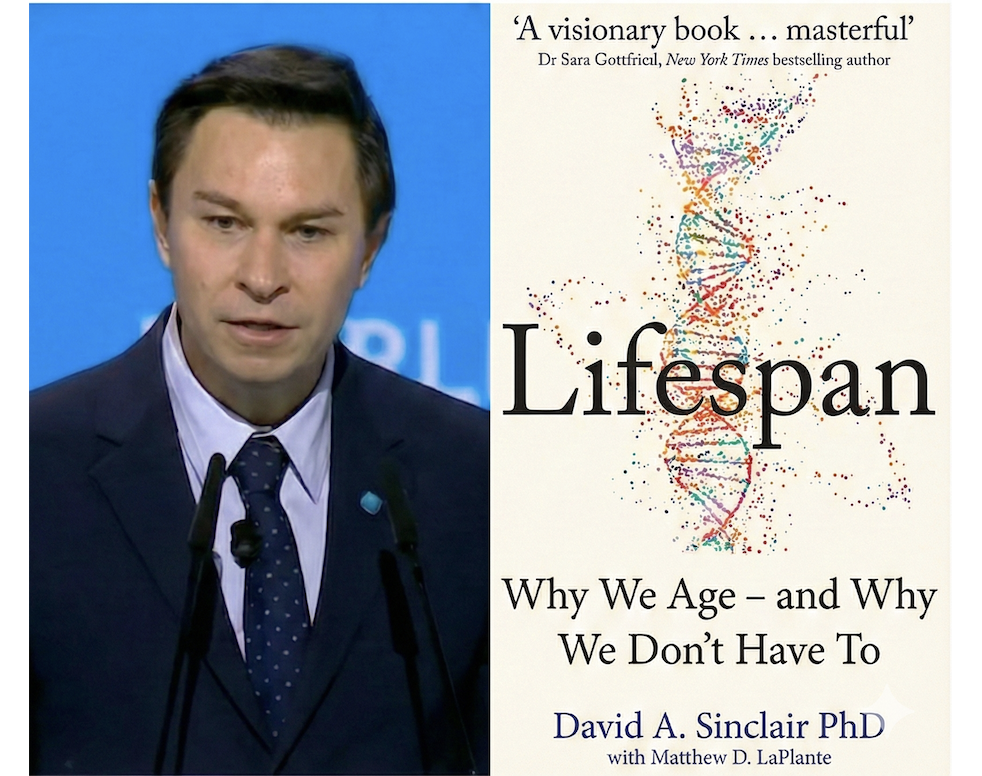
Life Biosciences, cofounded by Harvard geneticist David Sinclair, has received FDA IND clearance to begin the first-ever human trial of epigenetic age reversal. The therapy uses three of four Yamanaka factors to reprogram aged cells, reversing aging markers by 75% in animal studies. AI-powered drug discovery compressed what would have been decades of research into years.
What Is Epigenetic Age Reversal — and Why Does It Matter Now?
I've been a huge fan of Dr. David Sinclair for a long time, watching his work, and eagerly waiting for the trials he was doing in rats to be ready for humans — and that time has come — and AI is leading the charge.
David Sinclair has spent more than 25 years studying why we age. His central argument: aging is not the inevitable breakdown of the body. It's a loss of information — specifically, epigenetic information. Our DNA stays largely intact as we age, but the chemical markers that tell cells what to do gradually become scrambled. A liver cell starts to "forget" it's a liver cell. Sinclair's work suggests that if you can reset those markers, you can reverse aging at the cellular level.
In 2020, his team published a landmark study in Nature showing they could reverse blindness in old mice using three of four Yamanaka factors — the same proteins that earned Shinya Yamanaka the 2012 Nobel Prize in Medicine. In 2023, Sinclair published in Cell arguing that epigenetic change, not genetic mutation, is the primary driver of mammalian aging — and showed rejuvenation in mice.
Now, in 2026, his company Life Biosciences has received FDA IND clearance — not FDA approval, but clearance to begin testing — for the first human trial of this approach.
This is what makes this moment different from every other longevity headline. This isn't a supplement. It isn't a lifestyle hack. It's a direct attempt to reprogram human cells to a younger state — and the FDA has said the science is strong enough to try it in people.
How AI Compressed Decades of Research Into Years
The biology behind age reversal has been building for decades. But the speed at which it's now reaching human trials owes a significant debt to artificial intelligence. AI didn't discover epigenetic reprogramming — Sinclair and Yamanaka did that. What AI did was compress the research pipeline.
AI aging clocks — machine learning models trained on biological data — can now estimate a cell's "biological age" in hours instead of months. These tools let researchers measure whether a therapy actually makes cells younger, without waiting years for clinical outcomes.
AI-powered drug discovery platforms like Insilico Medicine's Medicine42 can screen thousands of molecular compounds and predict which ones are most likely to work — a process that used to take years of trial and error. In longevity research specifically, AI has helped identify new senolytic compounds, optimize dosing, and predict off-target effects before they reach animal models.
OpenAI now partners directly with Retro Biosciences, a longevity startup backed by Sam Altman with $180 million, to apply large language models to biological research. DeepMind's AlphaFold, which predicted the 3D structure of virtually every known protein, has opened entirely new avenues for understanding how aging works at the molecular level.
Sinclair gave us the biology. AI gave us the speed. Without machine learning compressing the drug discovery pipeline, we'd still be five to ten years away from a human trial. The convergence of these two fields is why 2026 is the year aging research crosses from animal models into human medicine.
The billionaire investment follows the science. Jeff Bezos funded Altos Labs with $3 billion to pursue cellular reprogramming. Sam Altman put $180 million into Retro Biosciences, confirmed by MIT Technology Review. Brian Armstrong of Coinbase invested $130 million in NewLimit, focused on epigenetic reprogramming. These aren't charity donations — they're bets that AI-accelerated longevity science is commercially viable.
The Full Timeline: How We Got Here
| Year | Sinclair's Work | AI Accelerating It |
|---|---|---|
| 1995 | Completes PhD in molecular genetics; moves to MIT to study yeast aging | — |
| Late 1990s | Co-discovers a cause of aging in yeast (sir2/rDNA circles) at MIT | — |
| 2003 | Publishes landmark resveratrol/sirtuin research in Nature | — |
| 2000s | Builds the case that epigenetic changes drive aging | — |
| 2020 | Publishes in Nature: uses 3 of 4 Yamanaka factors to reverse blindness in old mice | DeepMind's AlphaFold makes major breakthrough in protein structure prediction |
| 2023 | Publishes in Cell arguing epigenetic change drives mammalian aging, shows rejuvenation in mice | AI aging clocks and drug discovery platforms begin compressing the research pipeline |
| 2026 | FDA clears IND for first human trial of age-reversal therapy | OpenAI partners with Retro Biosciences on longevity; AI screens thousands of compounds at unprecedented speed |
Each row tells the same story from two angles: the biological breakthroughs on the left, and the AI acceleration on the right. The gap between Sinclair's first yeast discovery and a human trial is 31 years. Without AI compressing the pipeline, it would likely be longer.
David Sinclair's 25 years of research just crossed the threshold from animal models to human medicine. The FDA's IND clearance means the science is strong enough to test in people. AI didn't create the biology — but it compressed the timeline dramatically, turning what might have been another decade of preclinical work into a 2026 human trial. This is the year the longevity field gets real.