
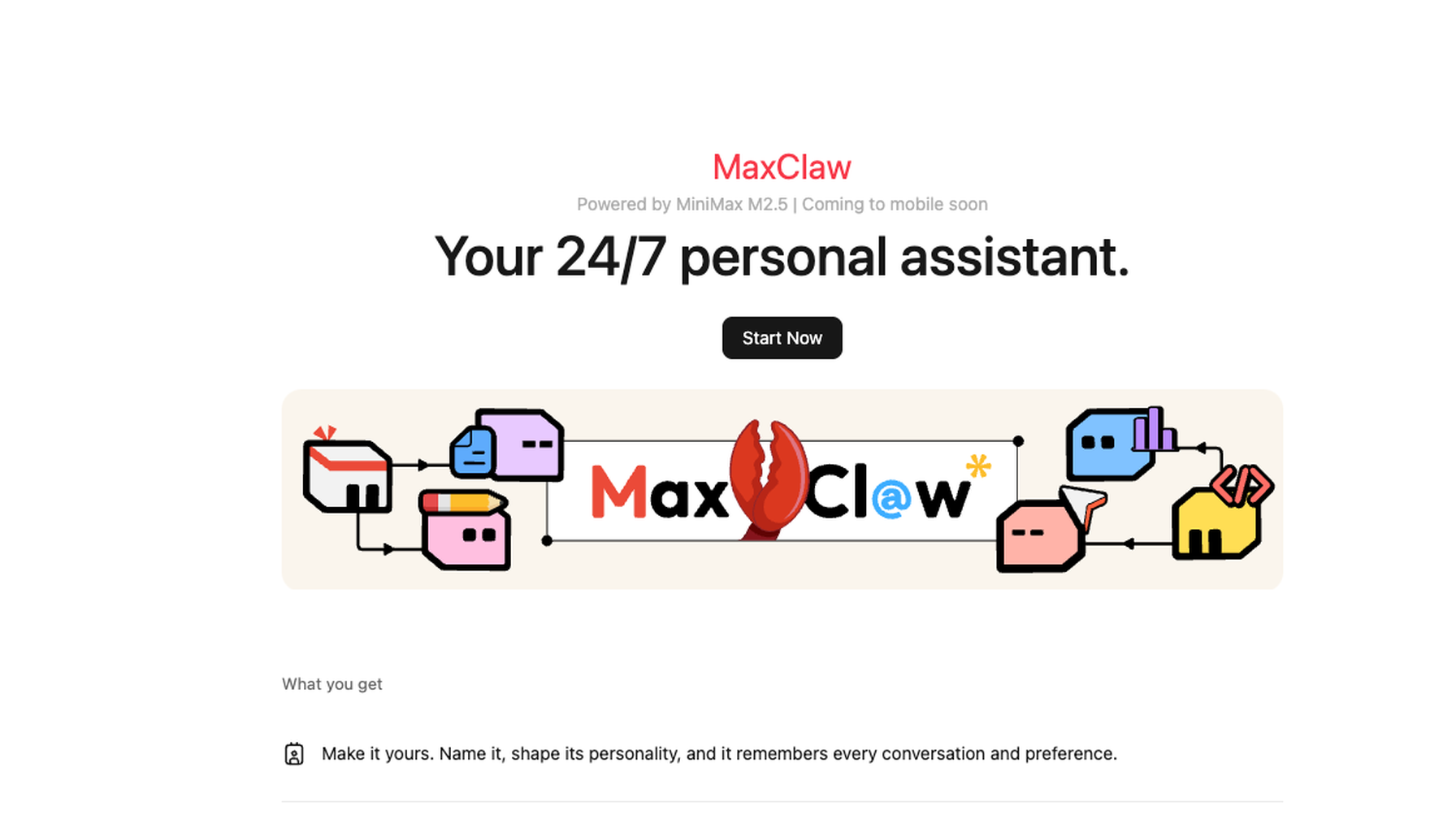
MaxClaw is MiniMax's cloud-hosted version of OpenClaw, the open-source AI agent with over 300,000 users. Launched this week, it runs on MiniMax's 229-billion-parameter M2.5 model and gives users a fully configured, always-on AI agent in under 20 seconds — no Mac, no VPS, no Docker, no API keys.
Why Did OpenClaw Need a Hosted Version?
OpenClaw has become one of the biggest open-source AI projects of 2025-2026. Created by Peter Steinberger, it's an autonomous agent that connects to Telegram, WhatsApp, Discord, and Slack and executes real-world tasks — managing email, running commands, deploying code, and remembering everything across sessions. It has over 300,000 users and 140,000 GitHub stars.
The problem is the setup. Running OpenClaw yourself requires Docker, API key configuration, and either a Mac or Linux machine — or paying for a VPS. For the majority of people who heard about OpenClaw on social media and wanted to try it, that's a wall.
MaxClaw removes that wall. Launched this week by MiniMax, it's a one-click cloud deployment that bundles the model, the infrastructure, and the integrations. You go to the MiniMax Agent platform, click Start Now, choose a configuration (or just pick Default), click I'm Ready, and you're live. The whole process takes under 20 seconds.
Think of it like this: OpenClaw is WordPress.org — powerful but self-hosted. MaxClaw is WordPress.com — they handle the infrastructure, you just start building.
What Does MaxClaw Come With?
MaxClaw ships with over 10,000 preloaded expert agents spanning software development, content creation, financial analysis, and market intelligence. These are specialized skill templates you can activate immediately — scriptwriting, lead generation, research, and more. Users can also create custom experts and publish them to the community.
Built-in capabilities include image and video generation, web search with real-time trend tracking, and application deployment. It also comes with pre-assembled workflows like viral content discovery and multi-agent research teams.
What makes MaxClaw significant isn't the technology — OpenClaw was already powerful. It's the accessibility shift. The open-source AI agent movement has been limited to developers willing to manage infrastructure. MaxClaw is MiniMax's bet that the next wave of adoption comes from removing that friction entirely. The timing also matters — OpenClaw creator Peter Steinberger joined OpenAI on February 14 and OpenClaw moved to a foundation, making this a land-grab moment for hosted providers.
The standout feature is native long-term memory. Unlike standard chatbot sessions that reset, MaxClaw agents remember your preferences, retain context across days or weeks of interaction, and accumulate knowledge from past tasks. The agent gets better the more you use it — without repeated prompting.
What Should You Watch Out For?
MaxClaw inherits OpenClaw's security profile. CrowdStrike has flagged OpenClaw's susceptibility to prompt injection attacks, where harmful instructions embedded in data could trick the AI into executing them. For individual creators and small businesses, the convenience likely outweighs the risk. For enterprise use cases with sensitive data, proceed carefully.
There's also platform dependency. OpenClaw itself is model-agnostic, but MaxClaw ties you to MiniMax's M2.5 and their cloud. If you want full control, self-hosting is still the move. If you want ease, MaxClaw is the fastest path in.
MaxClaw makes the most popular open-source AI agent accessible to anyone with a web browser — no Mac, no VPS, no technical setup. It's the easiest way to run OpenClaw today. For creators and small businesses looking to automate workflows without touching infrastructure, it's worth trying.