
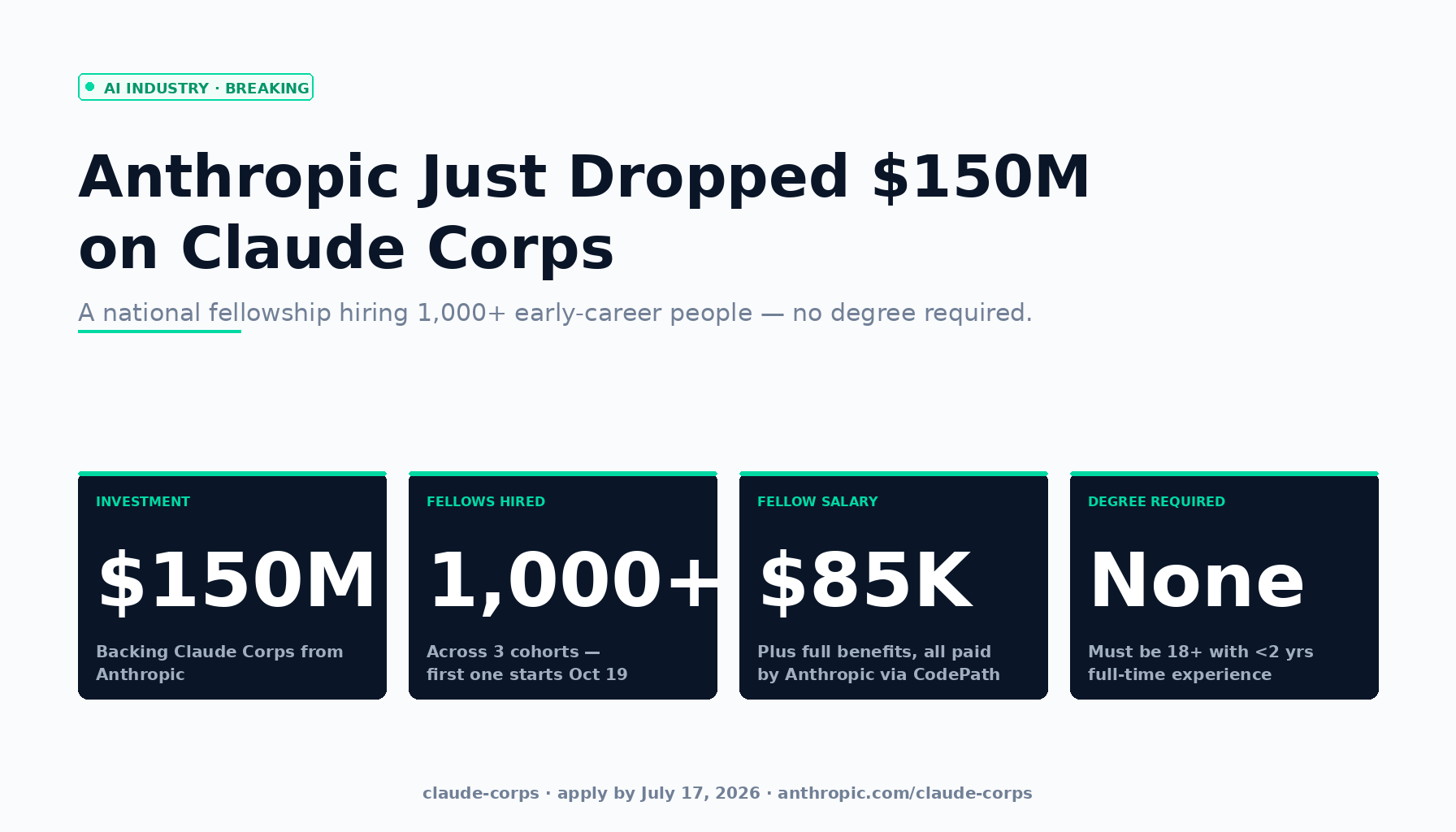
Anthropic just launched Claude Corps, a national fellowship backed by $150 million that will hire more than 1,000 early-career fellows over three cohorts. Fellows are paid $85,000 plus full benefits to embed inside US nonprofits for 12 months and put AI to work. No degree is required. The first cohort starts October 19, 2026, with applications closing July 17.
What is Claude Corps and what does it actually pay?
On June 11, Anthropic announced Claude Corps — a national fellowship program built in partnership with CodePath and Social Finance to place early-career professionals inside US nonprofits for a year. The pitch is simple. The nonprofits get a trained AI builder embedded full-time on their team. The fellow gets paid $85,000, full benefits, structured training every week, and a working portfolio at the end of twelve months.
The whole thing is backed by $150 million in funding from Anthropic, which makes this the largest workforce-development bet the company has placed to date — and one of the largest any frontier AI lab has placed on early-career hiring outside its own walls. Fellows are technically employed by CodePath, the nonprofit running the training side of the program, but the salary, benefits, and structural support are all underwritten by Anthropic.
The first cohort of 100 fellows starts October 19, 2026. Two more cohorts follow in January and August 2027, with the program scaling to more than a thousand fellows in total across the three intakes.
Anthropic has already named 19 host nonprofits for the first cohort, and the list is a real cross-section of American civic life. The International Rescue Committee in New York. RAINN in Washington, DC. The Grand Rapids Art Museum. Goodwill Industries International. Code for America. Year Up United. The Reef Environmental Education Foundation in the Florida Keys. The Montgomery County Food Bank in Texas. Team Red, White & Blue. The YMCA of Greater Charlotte and the YMCA of Greater Cincinnati. These are organizations where AI capability is genuinely scarce, and where a trained, paid builder on the inside for twelve months could change what they can do.
The training piece is the part most people will skim past, and they shouldn't. Fellows go through an intensive bootcamp before they ever set foot in their host organization. Then, throughout the fellowship year, they receive roughly five hours of structured training every week from CodePath, plus a designated mentor, an Anthropic technical contact, and a national cohort of peers building alongside them. They also get up to $2,500 in Claude API credits to spend on their projects.
That is not a side gig. That is a full year of paid, supported, on-the-job AI training inside a real organization with a real mission. The closest analog in the American workforce-development landscape is something like Teach for America — except instead of teaching, you are deploying AI tools, and the salary is meaningfully higher than what a first-year corps member would make in most of those programs.
Who can actually apply — and why this hiring filter matters
Here is where the news gets bigger than the dollar figure. The eligibility bar Anthropic set for Claude Corps is deliberately wide.
You need to be 18 or older. You need to have less than two years of full-time work experience. You need to be authorized to work in the United States. That is it. No degree required. No coding background required. No prior nonprofit experience required. According to the official program page, fellows are selected based on their experience with AI, their communication skills, and their motivation to work on societal challenges.
Read that filter twice. The selection criteria are not "where did you go to school" or "what languages do you write." They are "have you actually used AI in your daily life," "can you communicate," and "do you care." That is a fundamentally different shape of hiring filter than what new graduates have been bumping into for the last decade — and it has implications well beyond this one program.
Anthropic has been clear in its public messaging for the past year that it expects AI to displace meaningful chunks of entry-level white-collar work. CEO Dario Amodei has talked openly about this. Claude Corps reads, in part, as the company's first serious answer to the question of what happens to early-career talent in that world. Instead of waiting for the labor market to absorb the dislocation, they're paying a thousand people directly to learn the new skill stack on the job.
The most important word in the entire Claude Corps page is "demonstrated." Not "degreed." Not "credentialed." Demonstrated. If you have built anything with AI — a chatbot for your church, an automation for your side hustle, a tool that helps your mom plan meals — you have something to point at, and you should apply. The fellowship is going to be enormously competitive, but the filter rewards people who have already shown they can ship, not people who have already gotten a stamp on their resume. That is rare in American hiring right now, and it will not stay rare for long.
How to strengthen your application before July 17
The deadline is real. Applications close July 17, 2026, which gives you about a month from the date this article goes up. Four things matter most.
1. Complete the two required courses first. Before you do anything else, go to anthropic.skilljar.com and complete the AI Fluency and Claude 101 courses. You cannot submit the application without the completion certificates. Knock these out in the first week so you are not scrambling on July 16.
2. Create a GitHub account and build something small. The application has a GitHub or portfolio field. You do not need to be a software engineer to fill it. Build a simple Claude-powered chatbot. Wire together a no-code automation in Zapier or Airtable. Make a tool that solves one tiny real problem in your life. The point is to demonstrate that you have actually built something end to end — not that you can write production code.
3. Document what you built and what you would do differently. The application asks you to talk about a project honestly, including its flaws. Do not just show the finished product. Be ready to explain what you tried that didn't work, what you would change, and what you learned. That is the kind of self-aware build-and-iterate story this program is selecting for.
4. Connect it to social impact. The program explicitly wants to see "demonstrated pull toward community work." If you have any nonprofit experience, public-service experience, education experience, health-related volunteer work, or grassroots organizing in your background, surface it in the application. If you don't, spend two weeks before the deadline doing something small and real in your community and write about it honestly.
Apply at anthropic.com/claude-corps. Questions go to recruiting@claudecorps.org.
Anthropic is paying $150 million to put a thousand early-career people inside US nonprofits and train them on AI for a year. The filter rewards demonstrated builds over credentials. If you are 18+, under two years into your career, and you have ever shipped anything with AI — even something tiny — you should apply by July 17 at anthropic.com/claude-corps.